Design resilient, adaptable systems for complex work
Start with the situation, then identify the right service.
People usually approach me when the effects of pressure, change or lost potential are already visible. They know something deeper is happening, but you do not need to arrive with a diagnosis or know which service to ask for.
Bring me the ambition, the change you are navigating and where progress appears to be getting stuck. I help you make sense of what you are seeing and identify a proportionate place to begin.
I bring principles, evidence and practical methods that we can adapt to the people, work and systems involved.
My Neuro-Inspired Teams™ approach is designed to connect people with different expertise, perspectives and ways of thinking into a coherent way of working – without treating one way of contributing as the default.
The Future-Ready Teams Pathway™ provides a structured, evidence-informed route from recognizing what is happening to testing, embedding and sustaining what works.
Four common situations
Rather than asking you to fit your situation into a fixed service, I start by learning from what you are seeing, then draw on different approaches to shape support around what you are trying to achieve and what is getting in the way.
The four situations below are common starting points. Your situation may include more than one of them.

Team practice
How can I connect people with different strengths and expertise into a coherent way of working?
I help people in teams, functions and partnerships turn their distinct strengths and expertise into shared purpose and effective delivery – without standardizing away the differences.

Leadership practice
How can I support professionals to lead before – or beyond – a formal leadership title?
I help specialists and expert professionals understand themselves as leaders who shape groups, teams, partnerships and the wider organization, rather than as individual contributors.

System alignment
How can I align our systems with the new behavior we want to see?
I help identify where current systems – team, function, organization, network or community – conflict with stated expectations, then realign roles, routines, decision rights, recognition, incentives and measures so they point in the same direction.

Future-ready capability
How can I scale promising local practice into a resilient capability?
I help turn local experiments into evidence, resources and learning that others can use. We embed feedback loops and ownership so the capability can spread, adapt and remain effective as circumstances change.
The Future-Ready Teams Pathway™
A structured, evidence-informed route from recognizing what is happening to testing, embedding and sustaining what works.
The Pathway structures the change process without prescribing the solution. The methods and pace are adapted to the context.
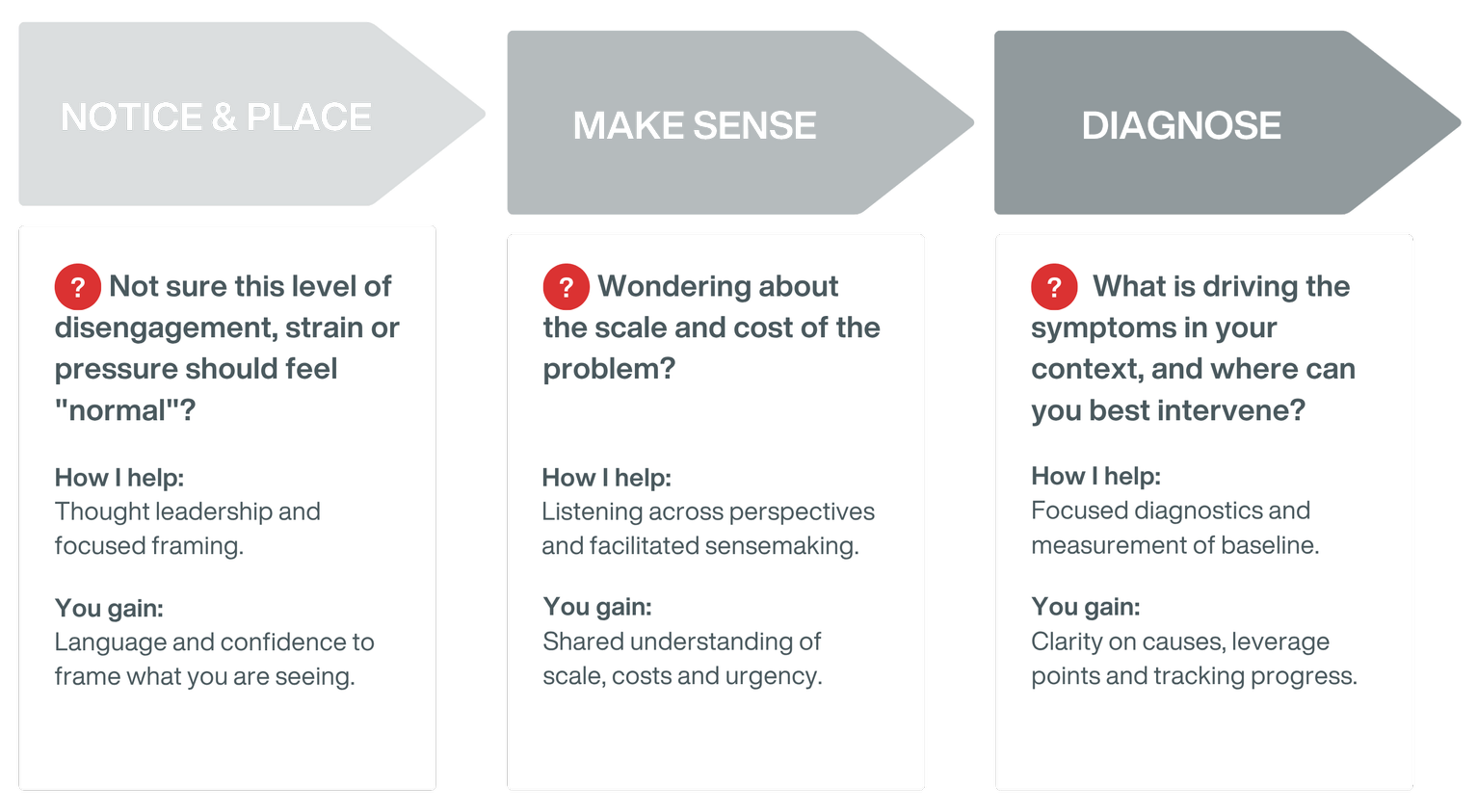
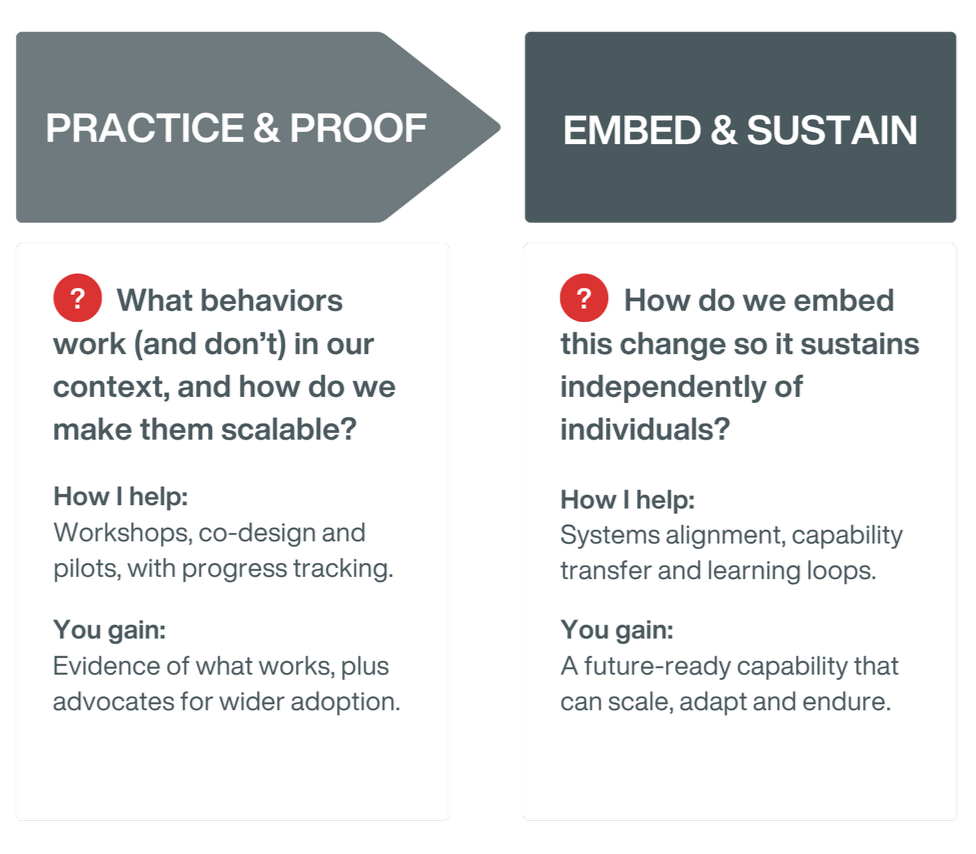
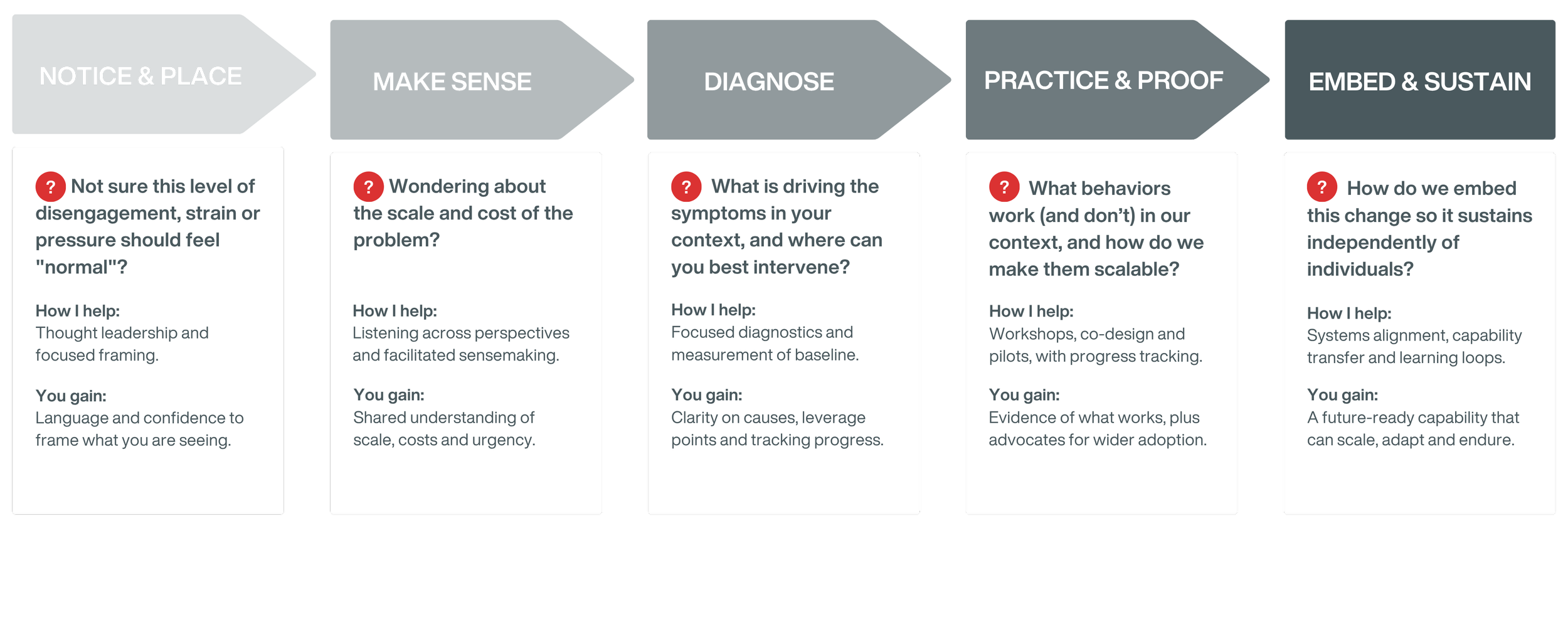
Many people who read this far recognize that their situation sits somewhere between Make Sense and Diagnose.
But different teams within the same organization, even different people within the same team, will be at different stages. That’s normal. The Pathway lets people and teams start from where they are.
Meaningful shifts can begin early in the process – often before any structural redesign begins.
Each evidence-informed step of this pathway is designed to reduce risk and produce:
Visible progress to drive motivation.
Practical materials that help others get involved and build momentum.
Clarity about what comes next – and the conditions needed for it to succeed.
Curious about which stage you’re at?
How the pathway unfolds in practice

What may be happening: something feels harder than it should – perhaps recurring strain, disengagement or friction – but it is not yet clear whether the issue is local, personal or systemic.
How we partner: we may begin with an article, talk, briefing or focused conversation that helps you recognize the pattern and place what you are seeing.
What this step produces:
A vague concern becomes visible and discussable.
A framing or resource that helps others recognize it too.
Clarity about whether deeper sensemaking is warranted.

What may be happening: people hold different parts of the picture, but there is no shared account of what is happening, its scale or its consequences.
How we partner: I listen across perspectives, facilitate collective sensemaking and synthesize relevant evidence to surface patterns, tensions and consequences.
What this step produces:
An account of what is happening and why it matters.
A synthesis of evidence that enables others to engage.
Agreement about what needs closer diagnosis and where to start.
What may be happening: you can see the symptoms, but need greater confidence about their causes, dependencies and the points at which intervention could make the greatest difference.
How we partner: I combine stakeholder insight, relevant evidence and systems thinking to distinguish symptoms from causes and clarify what to build, change or prioritize.
What this step produces:
A diagnosis distinguishing symptoms from underlying causes.
A prioritized map of dependencies, risks and leverage points.
A recommended practical first test – what to try, who to involve and how to recognize progress.
➡️ Case study: see how I diagnosed strengths and opportunities with The Collective’s leadership.

What may be happening: you need to establish which leadership and coordination behaviors improve execution, ownership and resilience in your context – and build credible evidence, practical resources and internal support for wider adoption.
How we partner: I design and deliver workshops, leadership development or team labs that help participants co-design and test new practices. Together, we gather qualitative and light quantitative evidence of what changes and why.
What this step produces:
Early, visible and measurable shifts in behavior and ways of working.
Practical tools and a small group of informed advocates who can help others adopt and adapt them.
Evidence of what works and under which conditions – informing decisions about whether and how to scale.
➡️ One possible starting point: explore the Leadership Workshop Series.
➡️ Case study: see how friendly connection became purposeful collaboration.
➡️ Case study: see how high performance was masking risk – and what changed.

What may be happening: promising practice exists but has not yet become part of how the wider system operates.
How we partner: we align roles, routines, governance, recognition, incentives, measures and resources; transfer ownership and capability; and establish learning loops through which people can revisit and adapt the practices as conditions change.
What this step produces:
The new practice becomes part of everyday work.
Clear ownership, reusable materials and supporting infrastructure enable it to spread.
People know how to revisit their norms, routines and measures to adapt them as circumstances change.
➡️ Case study: read about how I embedded neuro-inspired practices at scale.
Writing and thought leadership
Writing can support every stage of change. I also partner with organizations to turn evidence, experience and emerging practice into articles, reports and other resources that build shared understanding, strengthen positioning and influence the wider ecosystem.
As this capability becomes embedded, you see:
Clearer decision-making.
Stronger cross-functional alignment.
Leadership behavior that scales under pressure.
Lower coordination load carried informally by individuals.
Performance and growth that are both more consistent and more humane.
This is not about adding neuro-inclusion as a side project.
It is about strengthening your operating system for complex work – so people can contribute, coordinate and adapt as circumstances change.
If this feels like something your organization is navigating, let’s talk about the situation as you see it.


"Lisa's work on neuro-inclusive leadership resonated strongly with us at Bynder. What stood out in particular was how clearly it connects inclusive practices with broader team effectiveness and business outcomes - not only supporting neurodivergent colleagues, but strengthening how teams work together overall."
– Peter-Paul Houtman, Chief Technology Officer, Bynder